OWASP Top 10:2025 Web Application Security Risks

OWASP-Top-10-2025-Web-Application-Security-Risks

The Open Worldwide Application Security Project (OWASP) is a global, open community that provides guidance, tools, and best practices for improving application security. The OWASP Top 10 is the most widely recognized awareness document for developers, security professionals, and organizations to understand the most critical web application security risks. Compared to OWASP Top 10:2021, the … Read more

Mishandling of Exceptional Conditions in OWASP Top 10 (A10:2025)

Mishandling-of-Exceptional-Conditions-in-OWASP-Top-10-A10-2025

Mishandling of Exceptional Conditions is a new category introduced in the OWASP Top 10:2025. It focuses on applications that fail to properly handle unexpected errors, exceptions, or abnormal conditions. Poor exception handling can expose sensitive information, cause application crashes, create security vulnerabilities, or even allow attackers to perform further attacks. Applications should always handle errors … Read more

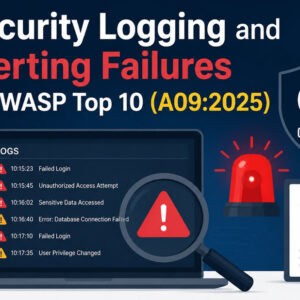
Security Logging and Alerting Failures in OWASP Top 10 (A09:2025)

Security-Logging-and-Alerting-Failures-in-OWASP-Top-10-A09-2025

Security Logging and Alerting Failures is ranked A09 in the OWASP Top 10:2025. Even if an application has strong security controls, they become ineffective if attacks are not detected. Without proper logging, monitoring, and alerting, organizations may remain unaware of security incidents for months or even years, allowing attackers to steal sensitive information without interruption. … Read more

Insecure Design in OWASP Top 10 : 2025

Insecure-Design-in-OWASP-Top-10-2025

Modern application security is not only about fixing coding errors and patching vulnerabilities. Many serious security issues originate much earlier—during the planning and design phase of an application. To address this concern, OWASP introduced Insecure Design as a separate category in the OWASP Top 10 in 2021, and it continues to be a critical risk … Read more

Cryptographic Failures in OWASP Top 10 : 2025

Cryptographic-Failures-in-OWASP-Top-10-2025

Cryptographic Failures (A04) remain one of the most critical security weaknesses highlighted in the OWASP Top 10 (2025). This category focuses on the improper implementation, weak usage, or complete absence of encryption mechanisms that protect sensitive data in modern applications. When cryptography is misconfigured or outdated, attackers can easily intercept, decode, or manipulate sensitive information … Read more

Software Supply Chain Failures in OWASP Top 10: 2025

Software-Supply-Chain-Failures-in-OWASP-Top-10-2025

Software Supply Chain Failures (A03) have emerged as one of the most critical cybersecurity concerns in modern software development. Organizations today rely heavily on third-party libraries, open-source packages, APIs, cloud services, operating systems, and external vendors to build and maintain applications. While these dependencies accelerate development, they also introduce significant security risks if not properly … Read more

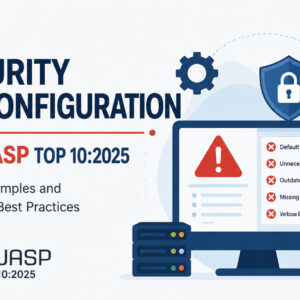
Security Misconfiguration in OWASP Top 10: 2025

Security-Misconfiguration-in-OWASP-Top-10-2025

One of the major vulnerabilities listed at number 2 is Security Misconfiguration (A02) in OWASP Top 10:2025. This vulnerability occurs when an application, server, framework, cloud service, or database is configured improperly, leaving security gaps that attackers can exploit. Security misconfiguration is one of the most common causes of application compromise because many organizations deploy … Read more

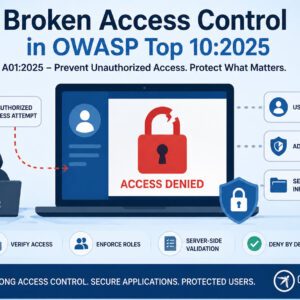
Broken Access Control in OWASP Top 10: 2025

Broken-Access-Control-in-OWASP-Top-10-2025

Broken Access Control (A01) is ranked as the first category in the OWASP Top 10:2025 because it remains one of the most dangerous and commonly exploited web application vulnerabilities. It occurs when users gain access to resources, pages, or data that they are not authorized to access. In simple terms, if an application fails to … Read more

Secure Coding Practices for Web Application Security

Secure-Coding-Practices-for-Web-Application-Security

Secure coding practices are a set of development techniques and security measures followed by software developers to minimize vulnerabilities during the software development lifecycle (SDLC). Security should be incorporated from the initial design and development phases rather than being added after deployment. Following secure coding standards, such as those recommended by the Open Web Application … Read more

Complete VAPT Testing Guide for Web Applications

Complete-VAPT-Testing-Guide-for-Web-Applications

Vulnerability Assessment and Penetration Testing (VAPT) is a critical practice for securing modern web applications. With cyber threats constantly evolving, organizations must proactively identify and fix security weaknesses before attackers exploit them. A structured VAPT process ensures thorough coverage, combining both automated tools and manual expertise to uncover vulnerabilities. Below is a detailed, step-by-step overview … Read more