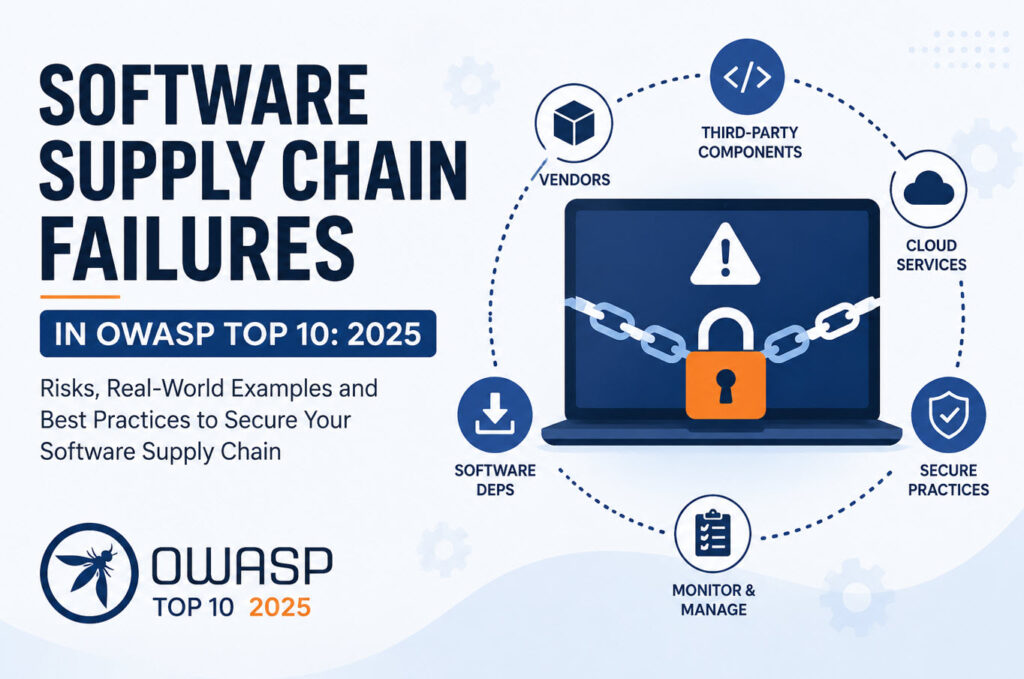
Software Supply Chain Failures (A03) have emerged as one of the most critical cybersecurity concerns in modern software development. Organizations today rely heavily on third-party libraries, open-source packages, APIs, cloud services, operating systems, and external vendors to build and maintain applications. While these dependencies accelerate development, they also introduce significant security risks if not properly managed.
Software Supply Chain Failures occur when weaknesses or security gaps exist in the process of developing, building, distributing, updating, or maintaining software components. Attackers often target these weaknesses to compromise applications, inject malicious code, or exploit known vulnerabilities within third-party components.
What Are Software Supply Chain Failures?
A software supply chain consists of all the components, tools, dependencies, vendors, repositories, build systems, and deployment mechanisms involved in delivering software to end users.
A supply chain failure occurs when any part of this chain becomes insecure, outdated, compromised, or improperly managed. Since modern applications often depend on hundreds of external components, a single vulnerable dependency can expose the entire application to cyberattacks.
When Is an Application Vulnerable?
An application may be vulnerable to software supply chain failures when:
- Organizations cannot identify or track the software components used directly or indirectly.
- Dependency versions are not properly documented or monitored.
- Operating systems, web servers, databases, APIs, frameworks, or libraries are outdated, unsupported, or vulnerable.
- Vulnerability scanning is not performed regularly.
- There is no inventory of software assets and dependencies.
- Supply chain components are not properly hardened.
- Software packages are downloaded from untrusted or unauthorized sources.
- Build servers and CI/CD pipelines lack security controls.
- Security measures are not consistently implemented across all parts of the software development lifecycle.
Real-World Examples of Software Supply Chain Failures
1. Compromised Vendor Updates
A trusted software vendor may become compromised by attackers. When customers install software updates from that vendor, malicious code can be unintentionally distributed across multiple systems.
This type of attack can affect thousands of organizations simultaneously because the malicious update appears legitimate and comes from a trusted source.
2. Distribution of Malicious Components
Developers may unknowingly install a malicious version of a software package or dependency. If the component is integrated into production systems without proper security validation, attackers may gain unauthorized access, steal data, or execute malicious code.
Such incidents are common in public package repositories where attackers publish packages that closely resemble legitimate software.
Security Impact
Successful software supply chain attacks can lead to:
- Remote code execution
- Data breaches
- Credential theft
- Malware infections
- Privilege escalation
- Service disruption
- Unauthorized system access
- Compromise of multiple organizations through a single vulnerable dependency
Because a single compromised component can affect many applications, supply chain attacks often have a much larger impact than traditional software vulnerabilities.
Commonly Mapped CWEs
Software Supply Chain Failures are commonly associated with the following Common Weakness Enumerations (CWEs):
- CWE-447 – Use of Obsolete Function
- CWE-1035 – Using Components with Known Vulnerabilities
- CWE-1104 – Use of Unmaintained Third-Party Components
- CWE-1329 – Reliance on Component That Is Not Updateable
- CWE-1357 – Reliance on Insufficiently Trustworthy Component
- CWE-1395 – Dependency on Vulnerable Third-Party Component
These weaknesses highlight the risks of relying on outdated, unsupported, or insecure software dependencies.
How to Prevent Software Supply Chain Failures
Organizations should implement the following security practices to reduce supply chain risks:
1. Maintain a Complete Software Inventory
Create and maintain a Software Bill of Materials (SBOM) that documents all components, libraries, frameworks, and dependencies used within applications.
2. Verify All Components
Review and validate every component used directly or indirectly by the application. Ensure that dependencies originate from trusted and verified sources.
3. Remove Unnecessary Components
Eliminate unused libraries, plugins, features, services, files, and packages that increase the attack surface.
4. Monitor Component Versions
Track all software versions used throughout the supply chain and continuously monitor them for newly disclosed vulnerabilities.
5. Perform Regular Vulnerability Scanning
Conduct automated vulnerability scans of applications, dependencies, containers, and infrastructure components on a regular basis.
6. Secure the CI/CD Pipeline
Protect build servers, source code repositories, artifact repositories, and deployment pipelines using strong authentication, access controls, and monitoring.
7. Apply Security Hardening
Implement proper hardening measures across all systems involved in the software supply chain, including:
- Regular patch management
- Secure configuration management
- Multi-factor authentication
- Access control enforcement
- Build server security
- Repository protection
- Continuous monitoring
8. Use Trusted Sources Only
Download software packages and updates only from trusted vendors, official repositories, and verified distribution channels.
For more information, visit the OWASP Top 10 website.
Software Supply Chain Failures represent a growing threat in today’s interconnected software ecosystem. As organizations increasingly rely on third-party components, attackers continue to exploit weaknesses in dependencies, build environments, and update mechanisms. By maintaining complete visibility of software components, performing continuous vulnerability assessments, securing CI/CD pipelines, and implementing strong supply chain security practices, organizations can significantly reduce the risk of supply chain attacks and protect their applications from compromise.