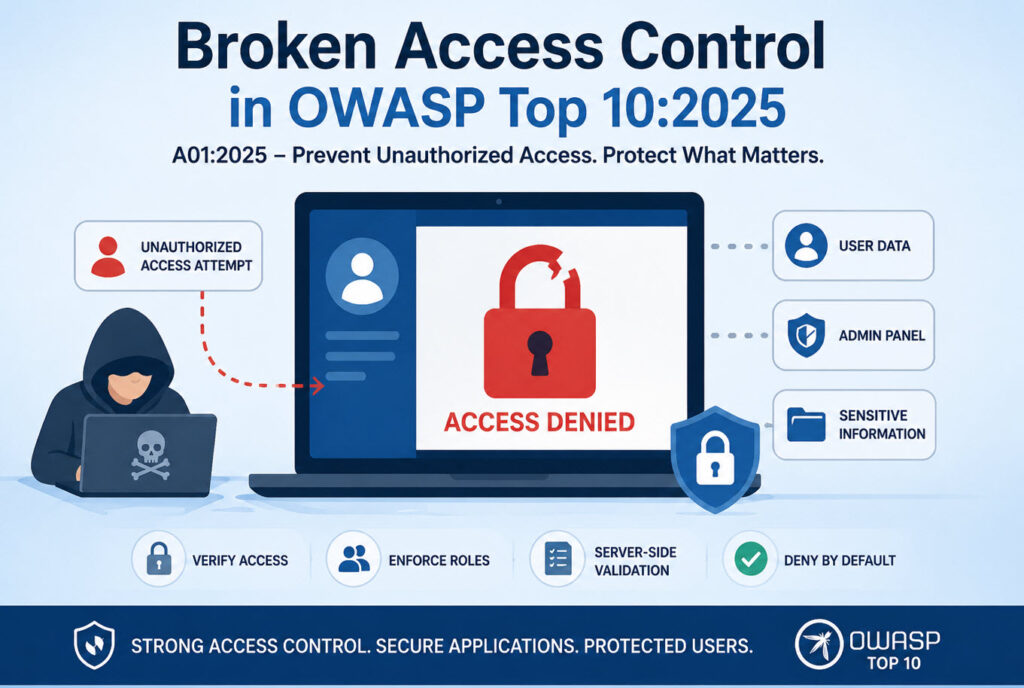
Broken Access Control (A01) is ranked as the first category in the OWASP Top 10:2025 because it remains one of the most dangerous and commonly exploited web application vulnerabilities. It occurs when users gain access to resources, pages, or data that they are not authorized to access. In simple terms, if an application fails to properly restrict user permissions, attackers can bypass security controls and access sensitive information.
Access control mechanisms are designed to ensure that users can only perform actions or access data based on their assigned privileges. When these controls are weak or missing, unauthorized users may view confidential records, access admin functionality, or manipulate application data.
What is Broken Access Control?
Broken Access Control happens when restrictions on authenticated or unauthenticated users are not properly enforced. Attackers exploit these weaknesses to perform unauthorized actions such as viewing other users’ accounts, modifying data, accessing hidden pages, or escalating privileges.
This vulnerability can affect both authentication and authorization mechanisms. Even if a user is properly authenticated, they should not be able to access resources outside their role or permissions.
Several Common Weakness Enumerations (CWEs) are associated with Broken Access Control, including:
- CWE-200: Exposure of Sensitive Information to an Unauthorized Actor
- CWE-201: Exposure of Sensitive Information Through Sent Data
- CWE-352: Cross-Site Request Forgery (CSRF)
- CWE-918: Server-Side Request Forgery (SSRF)
These weaknesses can lead to severe security breaches, data leaks, and unauthorized system access.
Common Broken Access Control Vulnerabilities
1. Access Granted Without Proper Authorization
Applications sometimes fail to enforce “deny by default” rules. As a result, users may gain access to resources that should only be available to privileged roles.
For example, a normal user may accidentally or intentionally access administrative functionality because authorization checks are missing.
2. Insecure Direct Object Reference (IDOR)
IDOR vulnerabilities occur when attackers manipulate URL parameters or identifiers to access another user’s data.
Example:
https://test.com/acinfo?account=someone_else_accountIf the application does not verify ownership or permissions, attackers can retrieve unauthorized account information simply by changing the parameter value.
3. Forced Browsing
Forced browsing happens when attackers manually access hidden or internal pages that lack proper authentication or authorization controls.
Example:
Normal page:
https://test.com/testinfoAdmin page:
https://test.com/admintestinfoIf an unauthenticated user directly visits the admin URL and successfully accesses it, the application is vulnerable to forced browsing.
4. Privilege Escalation
Privilege escalation occurs when attackers gain higher-level permissions than intended. A standard user may become an administrator due to weak access validation or insecure role management.
5. Front-End Only Validation
Some applications rely only on client-side validation. Attackers can bypass browser restrictions using command-line tools or direct API requests.
Example:
$ curl https://test.com/admintestinfoIf the backend server does not validate user permissions, attackers can directly access protected resources.
Impact of Broken Access Control
Broken Access Control vulnerabilities can have serious consequences, including:
- Unauthorized access to sensitive information
- Exposure of customer or financial data
- Administrative account compromise
- Data modification or deletion
- Regulatory compliance violations
- Full application takeover
Since access control flaws often expose critical business data, attackers actively target these vulnerabilities during penetration testing and real-world attacks.
Prevention Techniques for Broken Access Control
Organizations should implement strong authorization mechanisms to reduce the risk of Broken Access Control vulnerabilities.
Implement Server-Side Validation
Access control checks should always be enforced on the server side. Client-side validation alone is not secure because attackers can bypass browser restrictions.
Follow the Principle of Deny by Default
Applications should deny access unless explicitly granted. Public resources should be clearly separated from protected functionality.
Enforce Proper Role Validation
Every request should verify user roles and permissions before granting access to resources or actions.
Disable Directory Listing
Directory listing should be disabled to prevent attackers from discovering sensitive files or directories. Backup files and sample files should also be removed from web roots.
Expire Sessions Properly
After logout, authentication tokens and session identifiers must expire immediately on the server side.
Protect Against Parameter Tampering
Applications should validate all parameters and ensure users can only access their own authorized data.
Commonly Mapped CWEs
Several CWE categories are commonly linked to Broken Access Control vulnerabilities:
- CWE-22: Path Traversal
- CWE-219: Storage of Sensitive Data Under Web Root
- CWE-276: Incorrect Default Permissions
- CWE-284: Improper Access Control
- CWE-425: Forced Browsing
- CWE-540: Sensitive Information in Source Code
- CWE-548: Directory Listing Exposure
- CWE-552: Files Accessible to External Parties
- CWE-615: Sensitive Information in Comments
- CWE-749: Exposed Dangerous Methods
- CWE-922: Insecure Storage of Sensitive Information
Broken Access Control continues to be one of the most critical web security risks in the OWASP Top 10:2025 list. Weak authorization mechanisms can allow attackers to access restricted resources, escalate privileges, and compromise sensitive data. Organizations must implement strong server-side access validation, secure session handling, proper role management, and deny-by-default policies to protect applications from unauthorized access.
For more information, visit the official OWASP Top 10 website