
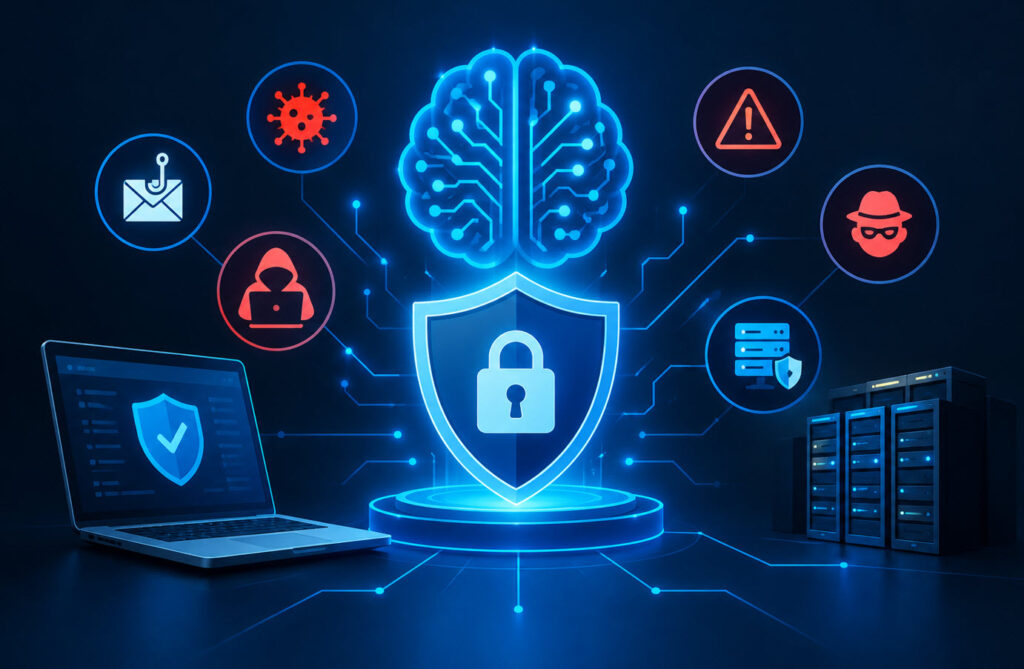
Artificial Intelligence (AI) is changing the way organizations approach cybersecurity. As cyberattacks become more frequent and attackers use more sophisticated techniques, security teams are looking for faster and smarter ways to identify and respond to threats. AI can analyze large amounts of security data, identify unusual activity, automate repetitive tasks, and help security professionals respond to incidents more quickly.
At the same time, AI is also being used by cybercriminals to improve phishing, malware, social engineering, and other attacks. This makes AI an important technology on both sides of the cybersecurity landscape.
What Is Artificial Intelligence in Cybersecurity?
Artificial Intelligence in cybersecurity refers to the use of AI and machine learning technologies to detect, analyze, prevent, and respond to security threats.
Traditional security solutions often depend on predefined rules, signatures, and known attack patterns. AI-based systems can analyze large volumes of data and identify patterns that may indicate suspicious behavior, including activity that has not been previously identified.
For example, an AI-powered security system may detect an unusual login location, abnormal network traffic, or unexpected process activity and flag it for further investigation.
How AI Helps Improve Cybersecurity
1. Faster Threat Detection
Security systems generate a huge amount of data from endpoints, servers, applications, firewalls, and network devices. Manually analyzing all these events can be difficult for security teams.
AI can process large volumes of security events quickly and identify patterns that may indicate malicious activity. This can help security teams detect potential threats earlier.
2. Detecting Unusual Behavior
AI can be used for behavioral analysis. Instead of looking only for known malicious signatures, systems can learn what normal activity looks like and identify significant deviations.
For example, if an employee normally accesses a small number of internal systems but suddenly starts accessing many sensitive servers, the activity could be flagged for investigation.
This approach can be particularly useful for detecting suspicious account activity and potential insider threats.
3. Automated Incident Response
Responding to security incidents can involve many repetitive tasks. AI can help automate some of these activities.
Depending on the security platform and its configuration, AI-assisted systems can prioritize alerts, collect relevant information, investigate indicators, or trigger predefined response actions.
Automation allows security teams to spend more time investigating serious incidents instead of manually processing every security alert.
4. Improved Malware Detection
AI can assist in identifying potentially malicious files and programs by analyzing their behavior and characteristics.
Traditional antivirus solutions commonly rely on known signatures. AI-based detection can also examine behavioral patterns and other characteristics that may indicate malicious activity.
This can provide an additional layer of protection against new or modified malware.
5. Better Phishing Detection
Phishing remains one of the most common methods used to target organizations and individuals. AI can analyze emails, URLs, domains, message content, and other indicators to identify suspicious communications.
AI can also help security teams identify patterns across large numbers of phishing attempts and improve detection over time.
How Cybercriminals Are Using AI
The impact of AI on cybersecurity is not limited to defensive security. Attackers can also use AI to make their activities more effective.
AI can help attackers create convincing phishing messages, automate certain reconnaissance activities, generate malicious or suspicious code, and create more personalized social engineering campaigns.
Generative AI can also make fraudulent messages more natural and reduce obvious spelling or grammar mistakes that traditionally made phishing emails easier to recognize.
This means organizations need to consider AI-assisted attacks when developing their security strategies.
Challenges of Using AI in Cybersecurity
Although AI provides many benefits, it is not a complete replacement for cybersecurity professionals.
One challenge is false positives. AI systems may sometimes identify legitimate activity as suspicious. If security teams receive too many inaccurate alerts, important threats can become difficult to identify.
Another concern is the quality of training data. AI systems depend on the data used to develop and improve their models. Poor-quality or incomplete data can affect detection accuracy.
Attackers may also attempt to manipulate AI systems or develop techniques specifically designed to evade AI-based security controls.
Privacy is another important consideration. Organizations must carefully manage sensitive information processed by AI systems and ensure that security and data protection requirements are followed.
The Future of AI in Cybersecurity
AI is likely to become increasingly integrated into cybersecurity platforms, including Security Information and Event Management (SIEM), Endpoint Detection and Response (EDR), Security Orchestration, Automation and Response (SOAR), email security, and vulnerability management.
Security professionals may increasingly use AI assistants to summarize alerts, investigate events, identify relationships between indicators, and support incident response.
However, human expertise will remain important. Security analysts need to understand the environment, validate AI-generated findings, investigate suspicious activity, and make decisions based on business and security requirements.
Conclusion
Artificial Intelligence is having a significant impact on cybersecurity by improving threat detection, behavioral analysis, malware detection, phishing identification, and security automation. At the same time, cybercriminals are using AI to develop more convincing and scalable attacks.
The most effective approach is not to treat AI as a replacement for cybersecurity professionals. Instead, organizations can use AI as an additional capability that helps security teams process information faster, reduce repetitive work, and respond to threats more efficiently.
As both attackers and defenders continue to adopt AI, combining intelligent security technologies with strong security practices and skilled professionals will remain essential for protecting modern digital environments.