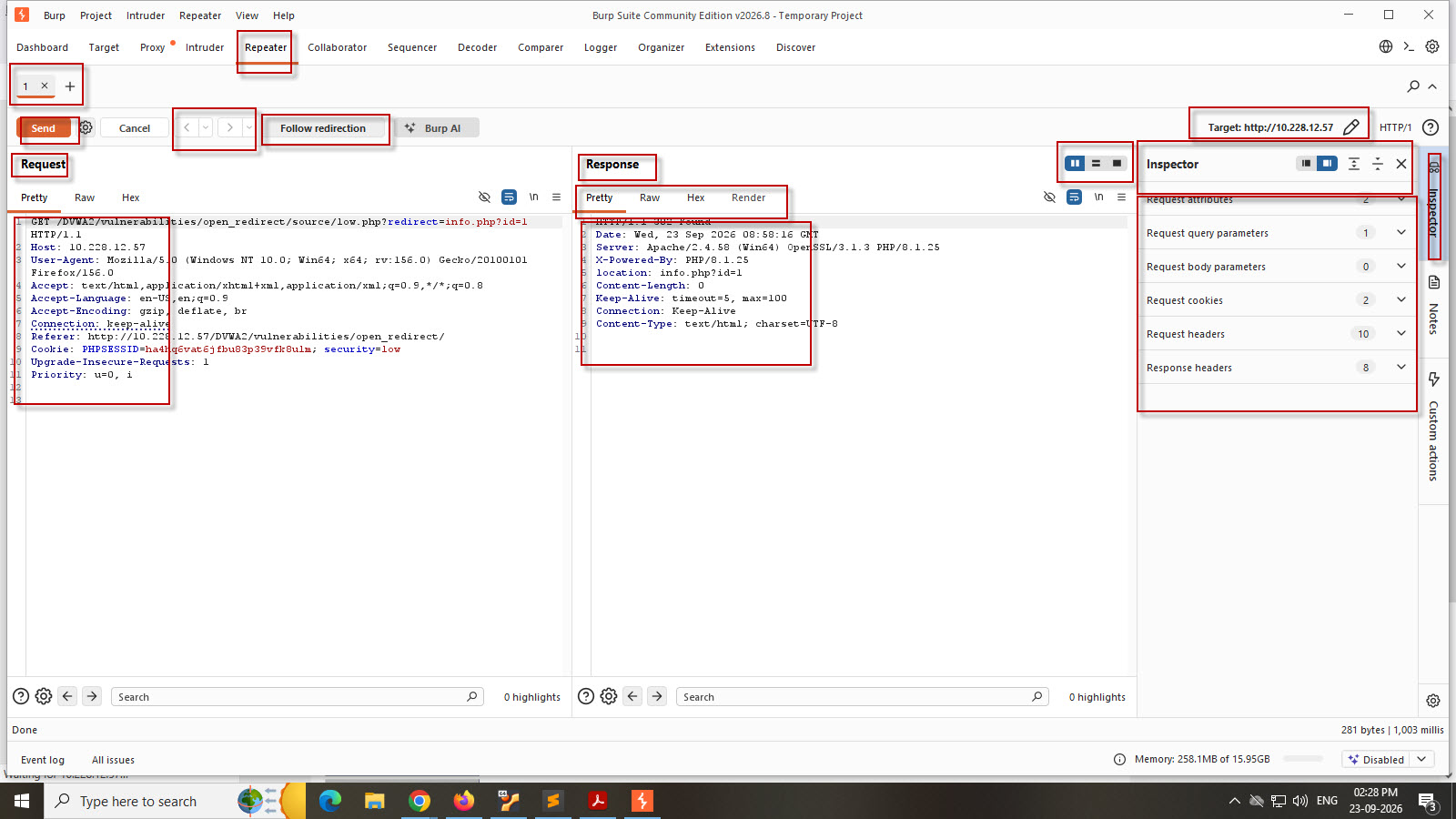
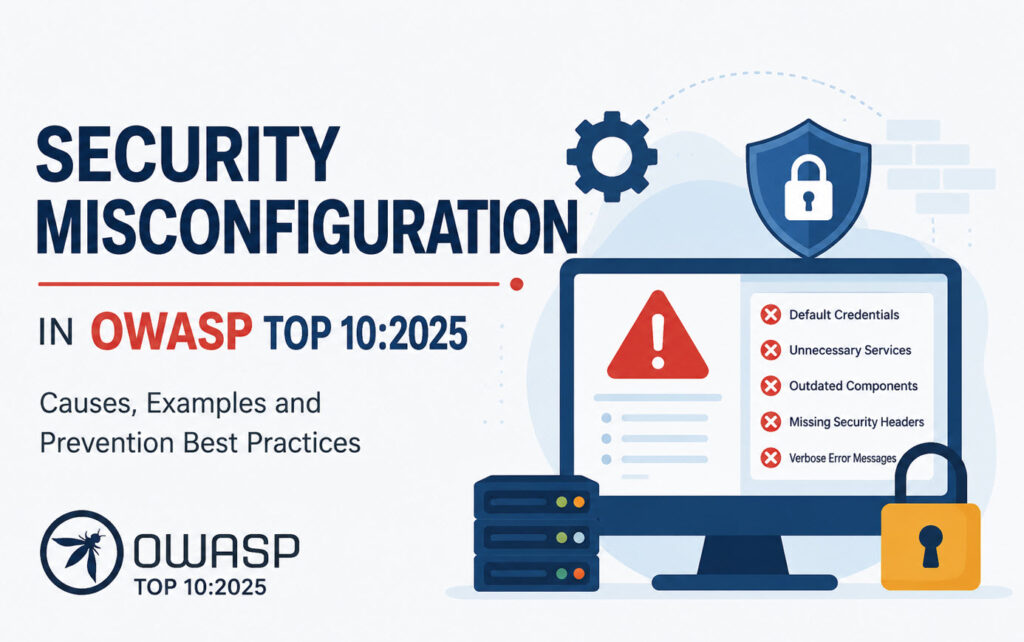
One of the major vulnerabilities listed at number 2 is Security Misconfiguration (A02) in OWASP Top 10:2025. This vulnerability occurs when an application, server, framework, cloud service, or database is configured improperly, leaving security gaps that attackers can exploit.
Security misconfiguration is one of the most common causes of application compromise because many organizations deploy applications with default settings, unnecessary services, weak configurations, or outdated components. Even a highly secure application can become vulnerable if the server or framework configuration is not managed properly.
What is Security Misconfiguration?
Security Misconfiguration happens when security settings are not implemented correctly at the application or infrastructure level. These weaknesses expose systems to unauthorized access, sensitive data leakage, remote code execution, and other cyberattacks.
Misconfigurations may exist in:
- Web servers
- Application servers
- Databases
- Cloud environments
- APIs
- Containers
- Frameworks and libraries
Attackers usually scan applications for common misconfigurations because they are easy to identify and often simple to exploit.
Common Causes of Security Misconfiguration
Below are the most common reasons why this vulnerability occurs in applications and servers.
1. Missing Security Hardening
Applications and servers should be hardened before deployment. If secure configurations are not applied properly, attackers can exploit weak settings and gain access to sensitive resources.
2. Unnecessary Services and Sample Files Enabled
Many servers contain:
- Unnecessary open ports
- Default services
- Testing pages
- Demo applications
- Sample files
These components may contain severe vulnerabilities that attackers can exploit.
3. Missing Security Headers
If secure HTTP headers are not configured correctly on the web server, applications become vulnerable to attacks such as:
- Clickjacking
- Cross-Site Scripting (XSS)
- MIME-sniffing attacks
- Session hijacking
Examples of important security headers include:
- Content-Security-Policy
- X-Frame-Options
- X-Content-Type-Options
- Strict-Transport-Security
4. Default Accounts and Passwords
Default usernames and passwords are one of the biggest security risks. Attackers often try publicly known credentials like admin/admin to compromise systems.
5. Outdated Frameworks and Components
Using old or unpatched software frameworks, plugins, or libraries can expose applications to known vulnerabilities.
6. Improper Security Settings
Incorrectly configured permissions, weak access controls, insecure cloud storage, and disabled security mechanisms can all lead to exploitation.
7. Improper Error Handling
Applications sometimes reveal detailed error messages containing:
- Stack traces
- Framework versions
- Database details
- Server paths
- Configuration information
This information helps attackers identify vulnerabilities quickly.
Real-World Examples of Security Misconfiguration
Example 1: Detailed Error Messages
An application server displays complete stack traces and framework version information whenever an error occurs. If the framework version is vulnerable, attackers can use publicly available exploits to compromise the application.
Example 2: Vulnerable Sample Applications
While deploying a production application, developers accidentally leave sample applications or testing pages enabled on the server. These applications may contain critical vulnerabilities that attackers can exploit to access the main authentication system.
Example 3: Directory Listing Enabled
If directory listing is not disabled, attackers may discover:
- Backup files
- Source code
- Configuration files
- Log files
Attackers can analyze or decompile these files and use the information for further attacks.
Commonly Mapped CWEs
Security Misconfiguration is associated with multiple Common Weakness Enumerations (CWEs), including:
- CWE-5 – J2EE Misconfiguration: Data Transmission Without Encryption
- CWE-11 – ASP.NET Misconfiguration: Creating Debug Binary
- CWE-13 – ASP.NET Misconfiguration: Password in Configuration File
- CWE-15 – External Control of System or Configuration Setting
- CWE-16 – Configuration
- CWE-260 – Password in Configuration File
- CWE-315 – Cleartext Storage of Sensitive Information in a Cookie
- CWE-489 – Active Debug Code
- CWE-526 – Exposure of Sensitive Information Through Environmental Variables
- CWE-547 – Use of Hard-coded Security-relevant Constants
- CWE-611 – Improper Restriction of XML External Entity Reference
- CWE-614 – Sensitive Cookie Without Secure Attribute
- CWE-776 – Improper Restriction of Recursive Entity References in DTDs
- CWE-942 – Permissive Cross-domain Policy with Untrusted Domains
- CWE-1004 – Sensitive Cookie Without HttpOnly Flag
- CWE-1174 – ASP.NET Misconfiguration: Improper Model Validation
How to Prevent Security Misconfiguration
1. Perform Proper Security Hardening
Servers, applications, databases, and cloud environments should be securely hardened before deployment. Staging and production environments should have the same secure configuration to avoid unexpected vulnerabilities.
2. Remove Unnecessary Components
Delete or disable:
- Sample applications
- Testing pages
- Unused services
- Unnecessary ports
- Default files
Reducing the attack surface significantly improves security.
3. Configure Security Headers Properly
Web servers should implement strong security headers with secure values to protect against common web attacks.
4. Implement Secure Error Handling
Applications should display generic error messages to users while detailed logs should only be accessible to administrators.
5. Remove or Change Default Credentials
All default accounts, passwords, and unnecessary administrative accounts should be removed or updated with strong credentials.
6. Keep Software Updated
Always install updated and secure versions of:
- Frameworks
- Libraries
- Plugins
- Operating systems
- Web servers
Regular patch management helps prevent exploitation of known vulnerabilities.
Security Misconfiguration remains one of the most dangerous vulnerabilities in the OWASP Top 10:2025 because even small configuration mistakes can expose an entire application to attackers. Weak server settings, outdated software, default credentials, and exposed debug information can all become entry points for cybercriminals.
Organizations should follow secure configuration practices, regularly audit their environments, apply security hardening, and continuously update software components to minimize the risk of exploitation. Proper configuration management plays a critical role in maintaining a secure web application environment.