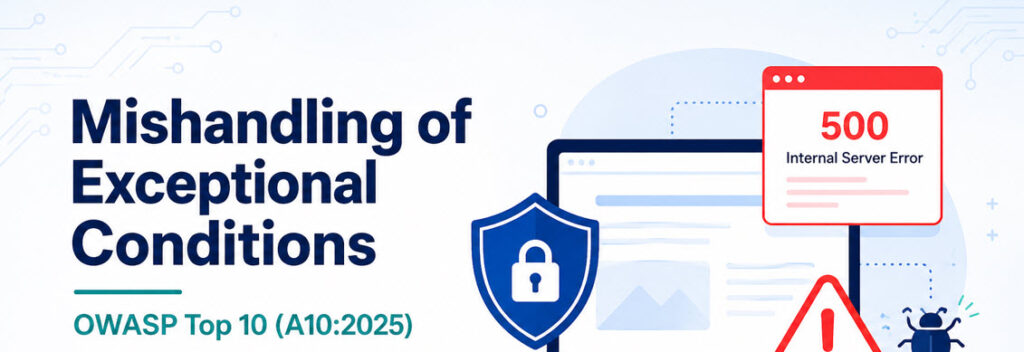
Mishandling of Exceptional Conditions is a new category introduced in the OWASP Top 10:2025. It focuses on applications that fail to properly handle unexpected errors, exceptions, or abnormal conditions. Poor exception handling can expose sensitive information, cause application crashes, create security vulnerabilities, or even allow attackers to perform further attacks.
Applications should always handle errors securely without revealing internal implementation details to users.
What is Mishandling of Exceptional Conditions?
This vulnerability occurs when an application does not properly manage unexpected situations such as invalid input, database failures, memory issues, network interruptions, or logical errors. Instead of failing securely, the application may expose confidential information or enter an insecure state.
Improper exception handling may reveal technical details about the application, making it easier for attackers to identify weaknesses and exploit them.
Common Causes
Some of the most common reasons behind this vulnerability include:
- Improper exception and error handling
- Lack of input validation
- Unhandled runtime exceptions
- Logical programming errors
- Failure to fail securely
- Memory or resource management issues
- Network or database failures that are not handled properly
- Missing custom error pages
Security Risks
Improper handling of exceptional conditions can lead to several security issues, including:
- Information disclosure
- Authentication and authorization bypass
- Logic flaws
- Memory-related vulnerabilities
- Resource exhaustion
- Application crashes
- Denial of Service (DoS)
Examples
1. Sensitive Information Disclosure
When an unexpected error occurs, the application may display detailed error messages containing:
- Database names
- Database file paths
- Server directories
- Stack traces
- Framework versions
- Operating system details
- Internal application configuration
This information helps attackers understand the application’s architecture and plan further attacks.
2. Denial of Service (DoS)
Suppose an exception occurs while processing a request and the application fails to release allocated resources such as memory, file handles, or database connections.
If an attacker repeatedly triggers this condition, the server eventually exhausts its available resources, causing legitimate users to experience service disruption or a complete Denial of Service (DoS).
How to Prevent Mishandling of Exceptional Conditions
Developers should design applications to handle every unexpected situation securely.
Recommended security practices include:
- Implement proper exception handling throughout the application.
- Catch and handle unexpected errors without exposing internal information.
- Display user-friendly custom error pages instead of system-generated errors.
- Perform strict input validation before processing user input.
- Use proper output encoding and escaping wherever applicable.
- Ensure failed transactions are rolled back to maintain data integrity.
- Release allocated resources such as memory, files, and database connections during exceptions.
- Monitor application logs continuously to identify repeated exceptions or possible attack attempts.
- Follow the principle of Fail Securely, ensuring the application remains secure even when errors occur.
Commonly Mapped CWEs
The following Common Weakness Enumerations (CWEs) are commonly associated with Mishandling of Exceptional Conditions:
- CWE-209 – Generation of Error Message Containing Sensitive Information
- CWE-215 – Insertion of Sensitive Information Into Debugging Code
- CWE-234 – Failure to Handle Missing Parameter
- CWE-248 – Uncaught Exception
- CWE-550 – Server-generated Error Message Containing Sensitive Information
- CWE-636 – Not Failing Securely
- CWE-755 – Improper Handling of Exceptional Conditions
- CWE-756 – Missing Custom Error Page
Mishandling of Exceptional Conditions is an important addition to the OWASP Top 10:2025 because even minor programming errors can become serious security vulnerabilities if they are not handled securely. Proper exception handling, secure error messages, robust input validation, effective resource management, and continuous monitoring help applications remain secure even when unexpected failures occur.
For more information, visit the official OWASP Top 10 project at https://owasp.org/www-project-top-ten/.