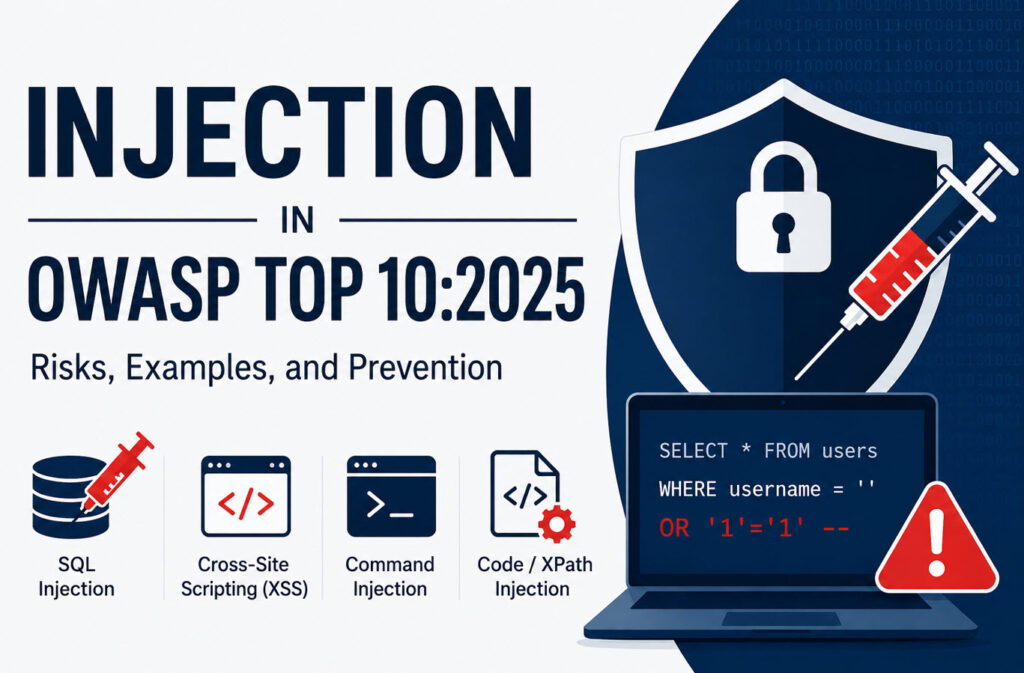
Injection vulnerabilities remain one of the most dangerous and widely tested security weaknesses in modern web applications. Listed as A05: Injection in the OWASP Top 10:2025, these vulnerabilities occur when untrusted user input is sent to an interpreter and executed as part of a command or query due to insecure application design.
Attackers exploit injection flaws by manipulating application inputs to execute unintended commands, access sensitive data, bypass authentication, or compromise entire systems. Because of their high impact and prevalence, injection attacks continue to be a primary focus during security assessments and penetration testing.
What is an Injection Vulnerability?
An injection vulnerability occurs when an application fails to properly validate, sanitize, or parameterize user-supplied input before processing it through an interpreter such as:
- SQL databases
- Operating system command shells
- LDAP services
- XPath processors
- Web browsers (JavaScript execution)
As a result, malicious input can alter the intended behavior of the application and execute attacker-controlled commands.
Some of the most common injection vulnerabilities include:
- SQL Injection (SQLi)
- Cross-Site Scripting (XSS)
- Command Injection
- XPath Injection
- Code Injection
When Does an Injection Vulnerability Exist?
An application may be vulnerable to injection attacks when:
1. Missing Input Validation
User-supplied data is accepted without proper validation, filtering, or sanitization.
2. Dynamic Query Construction
Applications build database queries or commands dynamically using string concatenation instead of secure parameterized methods.
3. Unvalidated Data in Commands
User input is directly included in:
- SQL queries
- Stored procedures
- Operating system commands
- LDAP queries
- XPath expressions
without proper validation or escaping.
4. Insufficient Security Testing
Input fields, URL parameters, headers, cookies, and API requests are not adequately tested for malicious payloads.
SQL Injection Example
Consider the following vulnerable code:
String query = "SELECT * FROM employees WHERE employeeNumber='" + request.getParameter("employeeNumber") + "'";In this example, user input is directly concatenated into the SQL query.
Attack Payload
An attacker modifies the employeeNumber parameter as follows:
' OR '1'='1Attack URL:
http://test.com/employee/view?employeeNumber=' OR '1'='1Resulting SQL Query
SELECT * FROM employees WHERE employeeNumber='' OR '1'='1'Since the condition '1'='1' is always true, the database returns all employee records instead of a single employee record.
This demonstrates how a simple input manipulation can lead to unauthorized access to sensitive information.
Impact of Injection Vulnerabilities
Successful injection attacks can result in:
- Unauthorized access to sensitive data
- Authentication bypass
- Data theft and disclosure
- Data modification or deletion
- Remote code execution
- Full system compromise
- Regulatory compliance violations
- Financial and reputational damage
How Injection Vulnerabilities Are Detected
Security professionals identify injection flaws through:
Automated Testing
- Vulnerability scanners
- Dynamic Application Security Testing (DAST)
- Web application scanners
Manual Testing
Testing all user-controllable inputs such as:
- Form fields
- URL parameters
- API requests
- HTTP headers
- Cookies
- File uploads
Security testers attempt to inject malicious payloads and observe application behavior.
Common CWEs Associated with Injection
Injection vulnerabilities are commonly mapped to the following Common Weakness Enumerations (CWEs):
| CWE ID | Description |
|---|---|
| CWE-20 | Improper Input Validation |
| CWE-77 | Command Injection |
| CWE-78 | OS Command Injection |
| CWE-79 | Cross-Site Scripting (XSS) |
| CWE-80 | Basic XSS |
| CWE-89 | SQL Injection |
| CWE-94 | Code Injection |
| CWE-112 | Missing XML Validation |
| CWE-116 | Improper Encoding or Escaping of Output |
| CWE-643 | XPath Injection |
Injection Prevention Techniques
Preventing injection vulnerabilities requires a combination of secure coding practices and layered security controls.
1. Validate All User Input
Every user-controlled input should be validated before processing.
Best practices include:
- Allow-list validation
- Length restrictions
- Data type validation
- Character restrictions
Reject unexpected or malformed input immediately.
2. Use Parameterized Queries
Parameterized queries (prepared statements) ensure user input is treated as data rather than executable code.
Example:
PreparedStatement stmt = connection.prepareStatement("SELECT * FROM employees WHERE employeeNumber = ?");
stmt.setString(1, employeeNumber);
This approach prevents attackers from altering query logic.
3. Secure Stored Procedures
Stored procedures should use parameters securely and avoid dynamic query construction.
4. Implement Output Encoding
For web applications, encode output before displaying user-supplied content to prevent Cross-Site Scripting (XSS).
5. Apply Client-Side and Server-Side Validation
Client-side validation improves usability, but it can be bypassed.
Server-side validation must always be implemented to enforce security controls.
6. Follow the Principle of Least Privilege
Database accounts and application services should have only the minimum permissions required for operation.
7. Perform Regular Security Testing
Conduct:
- Penetration testing
- Code reviews
- Vulnerability assessments
- Secure development lifecycle reviews
to identify injection flaws before attackers do.
Injection vulnerabilities continue to be one of the most critical security risks identified in the OWASP Top 10:2025. These flaws occur when applications trust user input and allow it to influence commands, queries, or interpreters without proper validation and security controls.
Organizations can significantly reduce their exposure to SQL Injection, Command Injection, Cross-Site Scripting, and related attacks by implementing strong input validation, parameterized queries, secure coding practices, and comprehensive security testing. A proactive approach to application security is essential for protecting sensitive data and maintaining the integrity of modern applications.
For more information, visit the official OWASP Top 10 project at https://owasp.org/www-project-top-ten/.